29 July 2025
History is real, right?
Over the past two months, Deveron Projects’ current artist-in-residence Bojan Fajfrić has spent more time in the empty Huntly Museum than most. Formed of two large rooms off the entrance to Huntly Library, the museum used to house objects with connections to Huntly alongside touring exhibitions. From taxidermy to minerals, tools to cultural and archeological artifacts, the collection was representative of Huntly’s communities and of their place in the world – in its multi-layered complexity. Now and since its closure in 2011 just the traces of a museum remain: a sign, empty display cases, a few larger objects including a loom, church window and provost’s gowns, bottle green films over the windows to block damaging sunlight, doors locked.
As an artist, Bojan is interested in the slipperiness of history. Slippery in the subjectivity of narrative, representation and memory. That what is recorded is not always what is recalled, and that what is recalled is often personal, soft, mundane, random and day-to-day. He believes that this stuff is most revealing. History is real, right? His films grasp at this: following connections, reconstructing moments, stepping into others’ clothes, homes and experiences, real and fictional, to show how alternative narratives are as ‘meant to be’, as real, as the ones in the history books. Personal and collective memory collide on screen.
Early in his residency, Bojan gave an artists’ talk at Friday Lunch, our regular community lunch and talk. He described his practice in relation to growing up in former Yugoslavia, taking us on a whistlestop tour of Yugoslav history, weaving his personal memories with historical events and describing some of his films. He shared his hopes to make a collective film in Huntly, and invited everyone to join in with a new weekly experimental film club. He asked everyone about Huntly Museum and there was conversation about the attempts to reopen a museum in Huntly. Someone asked, ‘whose history was represented in the museum, anyway?’.
The obvious question when visiting an empty museum is where did everything go? While driving cross-county to Aberdeenshire Council’s Museum Store with local history enthusiast Ron Brander, we discussed what we might find. Ron’s memories of the museum and its contents, combined with his rigorous research into the local newspaper archives, gave us some ideas of objects that used to be part of Huntly’s collection: a taxidermied kiwi bird from Aotearoa New Zealand, local author George Macdonald’s manuscripts and costumes, artifacts from an archaeological dig at Huntly Castle, a collection of minerals, a neolithic clay beaker, among others.
The collection, housed in a discrete industrial building in Mintlaw, is one of the largest local authority collections in Scotland, with over 250,000 items. We were fortunate to be able to visit. The small team of six are working on a new museum project in Peterhead, funded through 'levelling up' funding post-Brexit. It’s a huge opportunity for the collections team to apply their expertise over the coming years. As a result, loans from the collection are paused until 2027 and usual public visiting of the store is suspended.
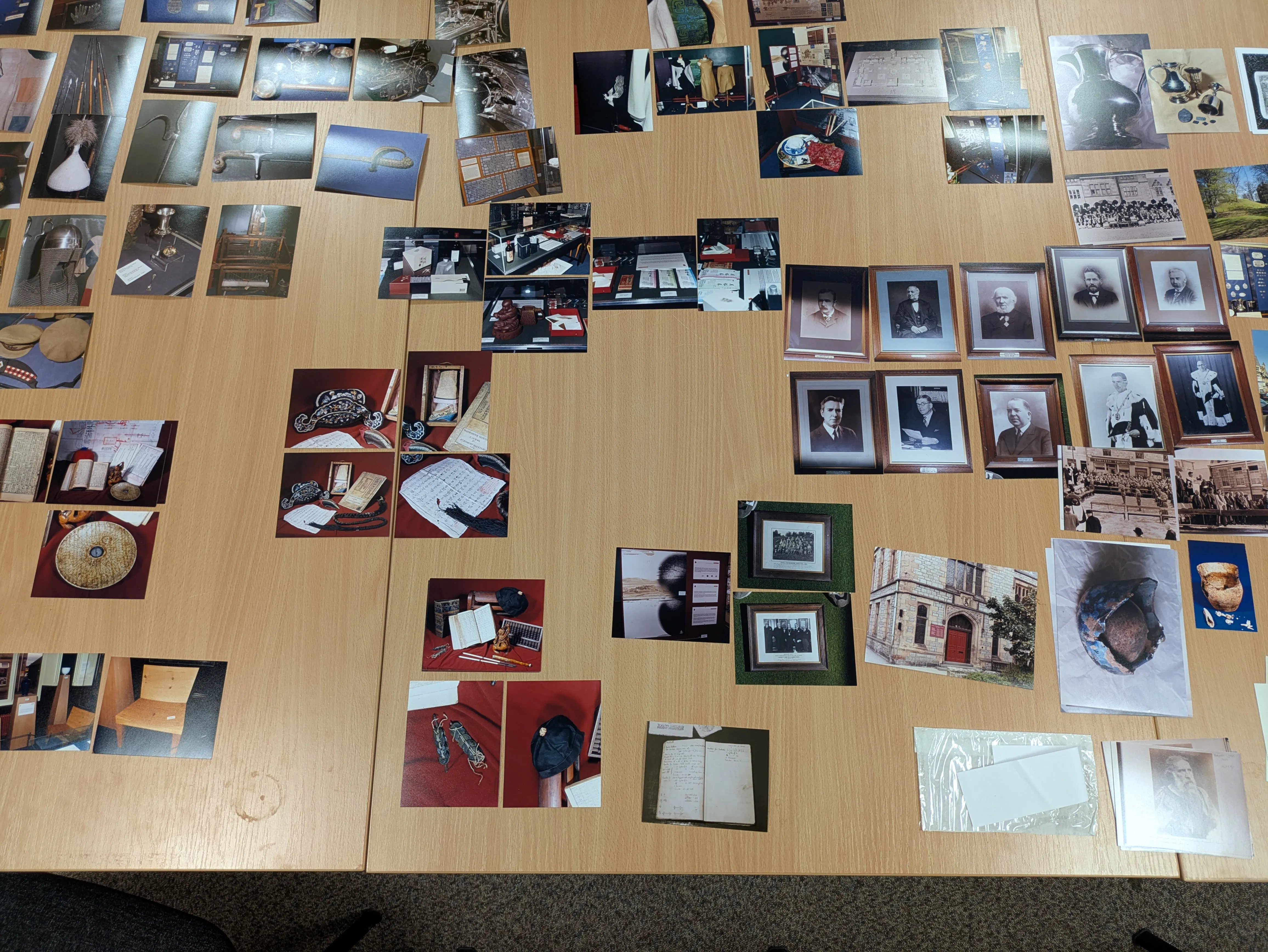
After touring four large warehouses, the scale and scope of the collection was overwhelming. The weight and presence of so many objects, very tangible. Eleven other local museums were closed alongside Huntly and beyond personal memories of the team and Ron, it wasn’t possible when touring the store to tell where an object had come from. We learned of challenges in accessing this information, including an update to accession numbering - new numbers don’t refer to the town of origin. As we were generously shown around we talked of the different labours involved in caring for a collection; practical, administrative, emotional. We randomly picked up some photos – some were of Ron’s family mill in Huntly – his Uncle Charlie and where he played as a child. Some were of Huntly Museum – these could be pieced together to reveal an exhibition, showing the contents of the now empty vitrines, objects and artifacts, on display in the Brander Building.
We decided to open one of the museum rooms as an event during the monthly Huntly Farmers’ Market and to invite local community members to come and have a look. Bojan filled the empty vitrines with images of Huntly – personal videos from Facebook, souvenir films of notable events such as the 2000 Gordon gathering, a test film he had made of Lindy who used to work in the museum coming into the rooms for the first time in years and trying to remember what was displayed. We printed photos we had taken of the photos we found at the store. People who remembered the museum reminisced – they spoke of the taxidermy, visiting as children with the school, the gift shop. Many people didn’t know there was a museum, and were interested to learn about it. Some were angry that the museum had been closed and the artifacts within had been removed from the town.
Everyone who came in was invited to join the weekly Alternative Film Club hosted by Bojan, by now running for several weeks. Each week’s programme responded to the week before, and people who were coming along regularly had started suggesting films to which Bojan would respond and build a programme around their nomination. Films ranged from Yugoslav Black Wave to Doric animations by local author Aaron Gale, films documenting performances to films that had been censored or banned for their political challenge.
Some of the few items left in the former museum room are a series of large, green bound books, each holding one year of local newspaper editions, The Huntly Express. Describing and documenting life in Huntly, Bojan starts reading in the 1990s, looking for any mention of the political upheaval and civil wars in Yugoslavia, or more generally, international connections referenced in the local paper. He meets with Pat Scott, who used to be the journalist at the Huntly Express for over 40 years, to ask about specific stories and people who are included. With a precise and comprehensive memory, Pat easily recalls the articles Bojan describes and knows who the articles were about. She tracks them or their families down – the man from Glass who was travelling in China and his account of the horrific Tiananmen Square Massacre, the young person from Croatia who cycled through Huntly in 1991, the writer of the article reflecting on the UK joining the European Economic Community. Unfortunately it is a dead end and all have moved or passed away. It was long ago now. We read the articles out loud in the museum room and Bojan makes a test film.
On a second visit to the museum store we met Jamie Cutts, the photographer in the museum service for over 30 years. Standing in the custom built studio (built to the dimensions required to photograph the largest painting in the collection), Jamie describes his role. He takes photos of the objects in the collection for the database, for publications and for use in exhibits. We learn that he trained as a ceramicist – of his passion for representing the object for not just what it looks like but what it actually looks and feels like. The time and care he takes over getting the lighting and backdrop right, trying to share the texture, colour, weight and depth of objects through the 2D medium of photography. How he looks for fingerprints in ceramic items because it connects him with whoever made it.
We scanned the photos of the old Huntly Museum that we found on our previous visit. Jamie thinks it’s a touring exhibition in the photos and shares how he remembers the museums operating – how objects were loaned and moved across the collection and how touring exhibitions would travel from town to town. His colleague James reminisces about the old museum store in Huntly – home to taxidermy and geology – now Deveron Projects’ offices.
Throughout the visit, we reflected on how local museums become containers for a collective narrative and identity of a place. Many of the objects in Huntly Museum (and the other local museums) weren’t originally from here and were instead removed from their cultural homes by imperialists, missionaries, workers and even tourists. In many ways they tell the story of the movement of people, objects and cultures around the world. This is likely violent – objects taken through coercion, force or theft – though without detailed records, this is unknown. What does it mean if a town now feels ownership over these items? If these objects begin to represent how a place sees itself? We discuss repatriation and how this might feasibly be achieved for objects with no recorded origin. It would likely require additional expertise and work beyond what is currently available.
As we move into into the final month of Bojan’s residency, there are many connecting threads still to follow, unpick and explore. Bojan has filmed more tests in the museum rooms, drawing lines between these empty spaces with other places in the town through continuous shots. We returned to the Aberdeenshire Council Museum Store in Mintlaw to film with Jamie, identifying and spend time with objects that represent the complexity of ownership, museum labour, identity and censorship. Bojan has returned home to Amsterdam, but will return again in November to reconnect with collaborators and start work on a film.
Bojan Fajfrić is the artist selected for the 2025 Publics Residency in partnership with Mondriaan Fund. Further information about his residency at Deveron Projects can be found here.