11 December 2025
Home as flow

Advertisement in the Huntly Express (29 May 1908), p.7.
In this second of three blog posts, Deveron Project’s Co-producer Bruce Phillips reflects on how the HOME programme’s regular events create inclusive understandings of home. He introduces the idea of ‘home as flow’ and how this has played out through Friday Lunch events that have embraced the changing reality of Huntly while respecting its roots.
Home as flow
After organising Deveron Project’s HOME programme over the last few months I have been impressed at how welcoming and proactive the communities of Huntly are. This grassroots energy has been reflected through talks given by community members at our regular event Friday Lunch. On the second and fourth Friday of the month, Deveron Projects invites a guest speaker who lives or works in and around Huntly. After everyone has enjoyed a tasty meal, the guest speaker is welcomed to talk about something that they are passionate about. Subjects over the past year alone have included everything from biodiversity initiatives to mindfulness, and from astronomy to collective journaling among many others. In itself the variety of topics attests to a vibrant and inclusive community with people making positive contributions to life in the town and region. It is heartening that this dedication to a location and pride in place can prevail in a world where ideas of ‘home’ are conversely being used as a negative force.

Unpermissioned Saltire Flag flying from a lamppost in Aberchirder, Aberdeenshire. 18 October 2025. Photo: Bruce Phillips.
Throughout the second half of 2025 anti-refugee demonstrations and counter protests were held outside temporary housing for refugees and asylum seekers across the UK.[1] These occurred alongside un-permissioned St George flags being hung from lamp posts in England and similarly with the Saltire flag in Scotland.[2] Aberdeenshire was not immune with rallies held in Aberdeen, Banff and Peterhead. Saltire flags lined entire streets in Aberdeen and I even came across a flag zip tied to a lamppost in the neighbouring village Aberchirder. The symbolic co-option of these flags is intended to promote ideologies of White nationalism and to intimidate non-White/global majority peoples and an attempt to make them feel excluded from the national identity. These actions were also emboldened by certain politicians[3] calling for mass-deportations and to scrap Indefinite Leave to Remain.[4]
Having recently been granted indefinite leave to remain, I know that this immigration status is not easy to obtain. It is an expensive five year journey that requires you to prove to the Home Office how you are integrating into life in the UK and that you are committed to making it your home. In fact, the process strategically deters would-be residents as part of the UK’s ‘Hostile Environment’ policy.[5] It is a difficult, stressful and vulnerable process, and in fact immigration numbers have been in decline since 2021.[6] This leads me to consider that the real opposition to indefinite leave to remain is therefore not an argument against immigration but rather a thinly veiled subtext for xenophobic exclusion.
As a person with White-settler heritage from a former British colony, I have found this anti-immigration argument especially bewildering. Especially since my ancestors originally came from the Scottish Highlands[7] to create a new home in Aotearoa New Zealand as part of expanding the British Empire. This is further evident in newspaper advertisements in the Huntly Express as late as the early twentieth century encouraging Aberdeenshire folk to emigrate to countries such as Aotearoa, Australia and Canada. Over one million Scots answered this call and established new homes in faraway lands to farm, extract minerals, fell ancient forests and serve in the military.[8] One of my ancestors was even involved in surveying land to be divided up for homes in the 1840s. Of course that colonial home building was actually a form of home invasion by displacing an indigenous Māori population. We see various forms of this replicated throughout history and currently the world over such as Israel's occupation of Palestine, Russia’s war in Ukraine, China’s continued aggression against Taiwan and threats from the US to own and control Greenland, Cuba, Venezuela and others.
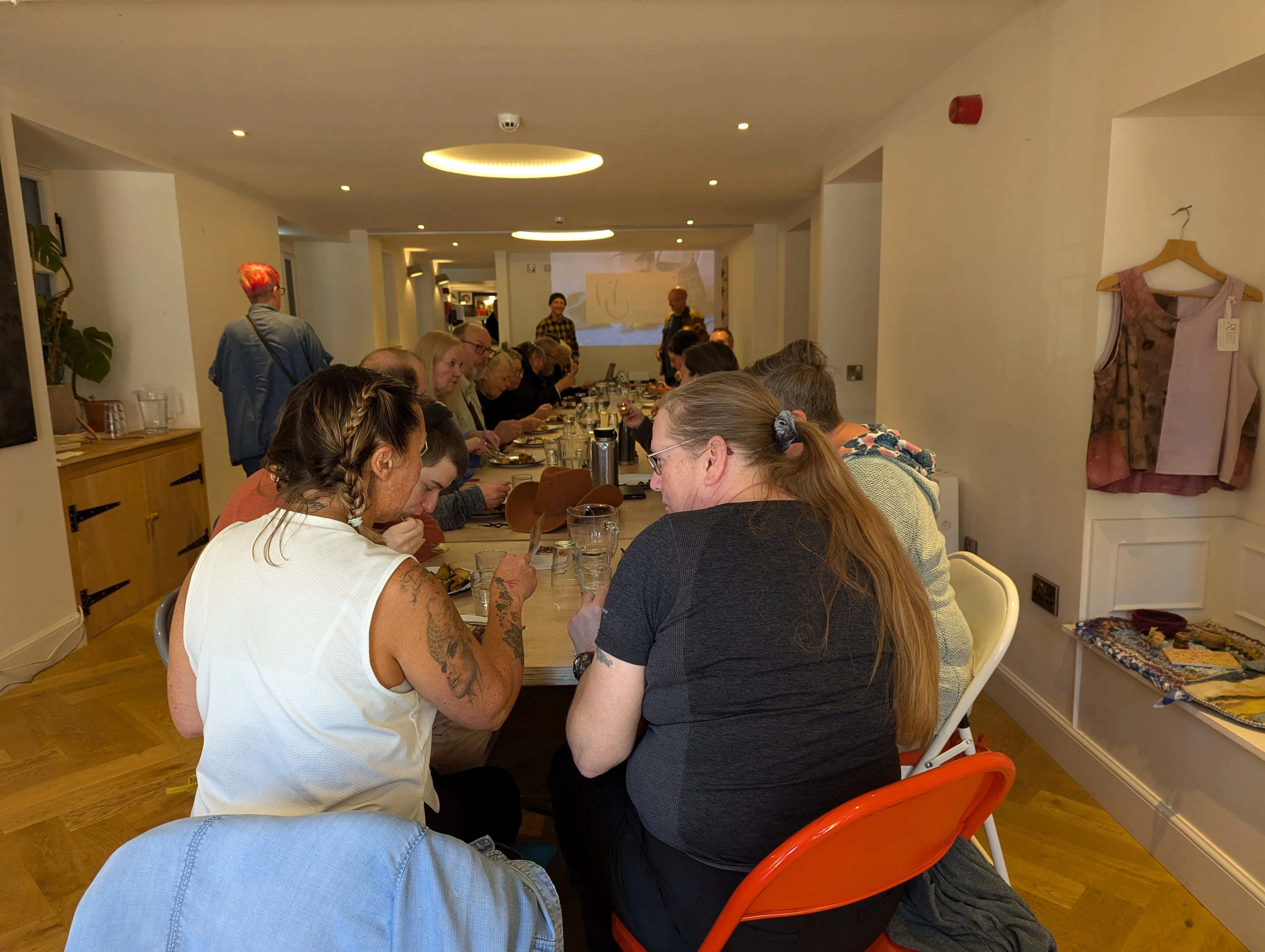
Friday Lunch with Naturally Useful, 1-2pm, Friday 10 October 2025.
This violent claiming of territory and using ideas of nationalism to exclude people, is all about gaining power over people and resources. Restrictive ideas of home are vital tools in enabling and justifying these motivations. When ‘home as place’ is considered something fixed and unchanging it is then able to be associated with one group of people and controlled, be that symbolically or physically. In reality home as ‘place’ is not stable but always changing. The more I think about it, the whole process of dividing the world into countries, regions, cities, towns, and private homes is a really strange concept. Sure it's practical and necessary for many good reasons. It's a bit like trying to own the air or water. Land is just as infinite and plentiful if we choose to readjust our relation to it.
In grappling with these ideas I often return to this quote by the geographer Yi-Fu Tuan. He writes: “If we think of space as that which allows movement then place is pause each pause in movement, makes it possible for location to be transformed into place."[9] I understand this to mean that ideas of place resist change by creating a perceived pause in the flow of space and time.
In his lecture Home as Elsewhere, Tuan further distinguishes between the notion of rootedness and a sense of place.[10] He argues that feeling rooted is about recognising and respecting a generational connection and relation to a location – as demonstrated by many indigenous peoples across the world. In comparison, a sense of place, according to Tuan, often involves romanticising the past of a place and creating place-based identities that limit what home can be and who can call it home in the present and future.
If we embraced this perspective, that places are not fixed but momentary pauses, perhaps our society would be tolerant of difference and more welcoming to newcomers. I wonder if we might even question ideas of land ownership. This proposition poses some important and hard to answer questions such as: how do we embrace change while respecting generational rootedness? And how do we resist negative forms of place-based identity that excludes people and/or place-making that draws on an idealised nostalgia of the past?
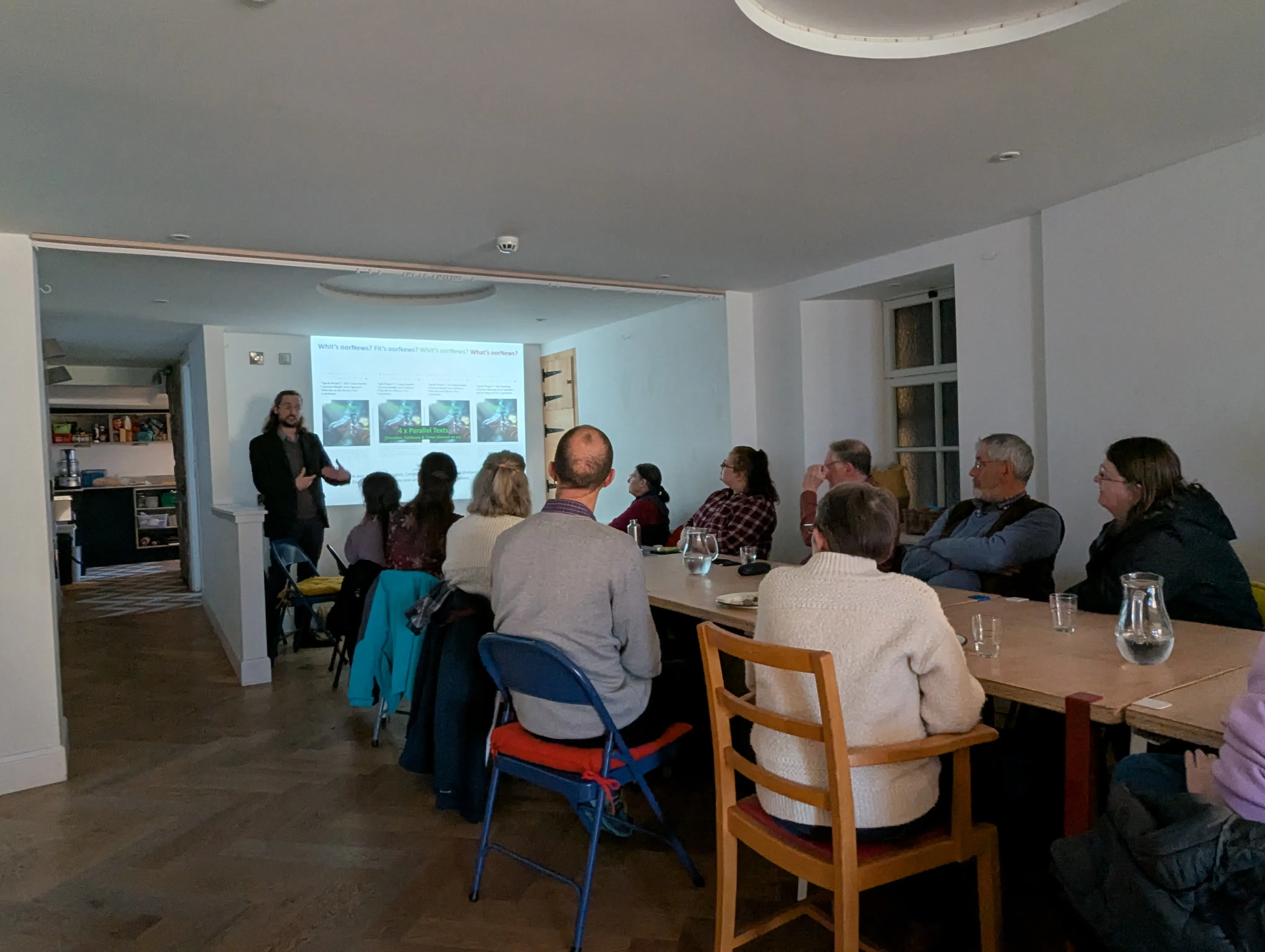
Friday Lunch: Spikkin Doric. Featuring Dr Rory MacDonald, the chief editor of oorNews. 1-2pm, 12 December 2025, Square Deal, Huntly.
These concerns have been addressed numerous times through the HOME programme in events like Friday Lunch. For instance, Huntly as a place in flow with the world, has been explored by people who have just moved to Huntly or Aberdeenshire, or who are just living here for a short while, such as many of the international artists undertaking residencies at Deveron Projects. Making space in Friday Lunch to represent the continual flow of people in Huntly has had a tangible impact on these guest speakers. They have expressed to me that these events have helped them connect and feel they are part of the community.
In terms of embracing rootedness, this is demonstrated in a talk given by Dr Rory MacDonald, the chief editor of oorNews, a Scots Language media start-up based in Monymusk, Aberdeenshire. For Friday Lunch, Rory shared his experience growing up as a native Doric and Scots speaker and having to navigate work and life speaking English “to avoid classist discrimination from those who have rejected their own Scots or to simply be understood by those without enough Scots”.[11] The systemic discouragement of native languages is a common experience for peoples that have experienced being colonised or dominated by another nation or culture. The insidious strategy here is to cut people off from their roots so that they are disempowered, disconnected and forced to integrate. Language movements are, therefore, much more than just communication. Language creates a positive sense of rootedness through feelings of belonging and self-worth as well as an ancestral connection and a sense of futurity. Similarly, Rory’s work with oorNews encourages a Scots-positive language culture and for people to reconnect with their roots. For newcomers, oorNews provides an opportunity to learn the language and develop an understanding of the culture they have been welcomed into. In this sense, ‘home as flow’ is about embracing the freedom of space over fixed ideas of place all the while respecting the roots that give inclusive belonging, meaning and connection.
References:
[1] In England the cities of Bristol, Glasgow, Liverpool, London Manchester and Newcastle received anti-refugee protests plus further rallies took place in many towns. In Scotland protests took place in Aberdeen, Banff, Dundee, Falkirk, Inverness and Peterhead. See:
Opposing rallies take place over Inverness barracks asylum plans (BBC News, 6 December 2025). Accessed 20 January 2026: https://www.bbc.co.uk/news/articles/clyd81vpz31o
Hundreds face off outside Falkirk hotel in asylum seeker protests (BBC News, 30 August 2025) Accessed 20 January 2026: https://www.bbc.co.uk/news/articles/czxyj5w5jn0o
[2] Phil Mackie and Ewan Somerville, National flags have started lining our streets. They may say something more (BBC News, 24 August 2025) Accessed 20 January 2026: https://www.bbc.co.uk/news/articles/cx271162ee3o
Libby Brooks and Severin Carrell, ‘Reclaim our flag’: saltire becomes cultural battleground in Scotland as tensions rise over asylum housing (The Guardian, Mon 06 Sep 2025). Accessed 20 January 2026:https://www.theguardian.com/uk-news/2025/sep/06/reclaim-our-flag-saltire-cultural-battleground-tensions-asylum-housing
[3] Eleni Courea and Jessica Elgot, Farage vows to scrap indefinite leave to remain, placing thousands at risk of deportation (The Guardian, Mon 22 Sep 2025). Accessed 20 January 2026: https://www.theguardian.com/politics/2025/sep/22/farage-vows-to-scrap-settled-status-placing-thousands-at-risk-of-deportation
[4] One of the last immigration stages before someone can apply to be a UK citizen.
[5] Now referred to as the ‘Compliant Environment’ policy.
[6] Mary Gregory, What is driving the current fall in net migration? (National Statistical News and insight from the Office for National Statistics, November 27, 2025). Accessed 20 January 2026: https://blog.ons.gov.uk/2025/11/27/what-is-driving-the-current-fall-in-net-migration/
Cachella Smith and Daniel Sandford, Sharp fall in UK net migration with drop in arrivals for work and study (BBC, 27 November 2025). Accessed 20 January 2026: https://www.bbc.co.uk/news/articles/c246ndy63j9o
[7] Also, England, Ireland and Wales.
[8] During the period 1821 to 1945. See: The Scottish Diaspora and Diaspora Strategy: Insights and Lessons from Ireland, Publication - Research and analysis, Scottish Government (29 May 2009). p.6.1. Accessed 3 April 2026: https://www.gov.scot/publications/scottish-diaspora-diaspora-strategy-insights-lessons-ireland/pages/6/
[9] Yi-Fu Tuan, Space and Place: The Perspective of Experience (University of Minnesota Press, 1977), 6.
[10] Yi-Fu Tuan, Home as Elsewhere (Geography, University of Wisconsin-Madison). Lecture: 4:00 pm Wednesday, March 9, 2011. McCune Conference Room, 6020 HSSB. Accessed 20 January: https://youtu.be/4jhyJeV1RAA
[11] Aboot / About, oorNews. Accessed 20 January 2025: https://oornews.co.uk/en/aboot-about/