28 June 2026
Take Liberty: The right to participate in a cultural life
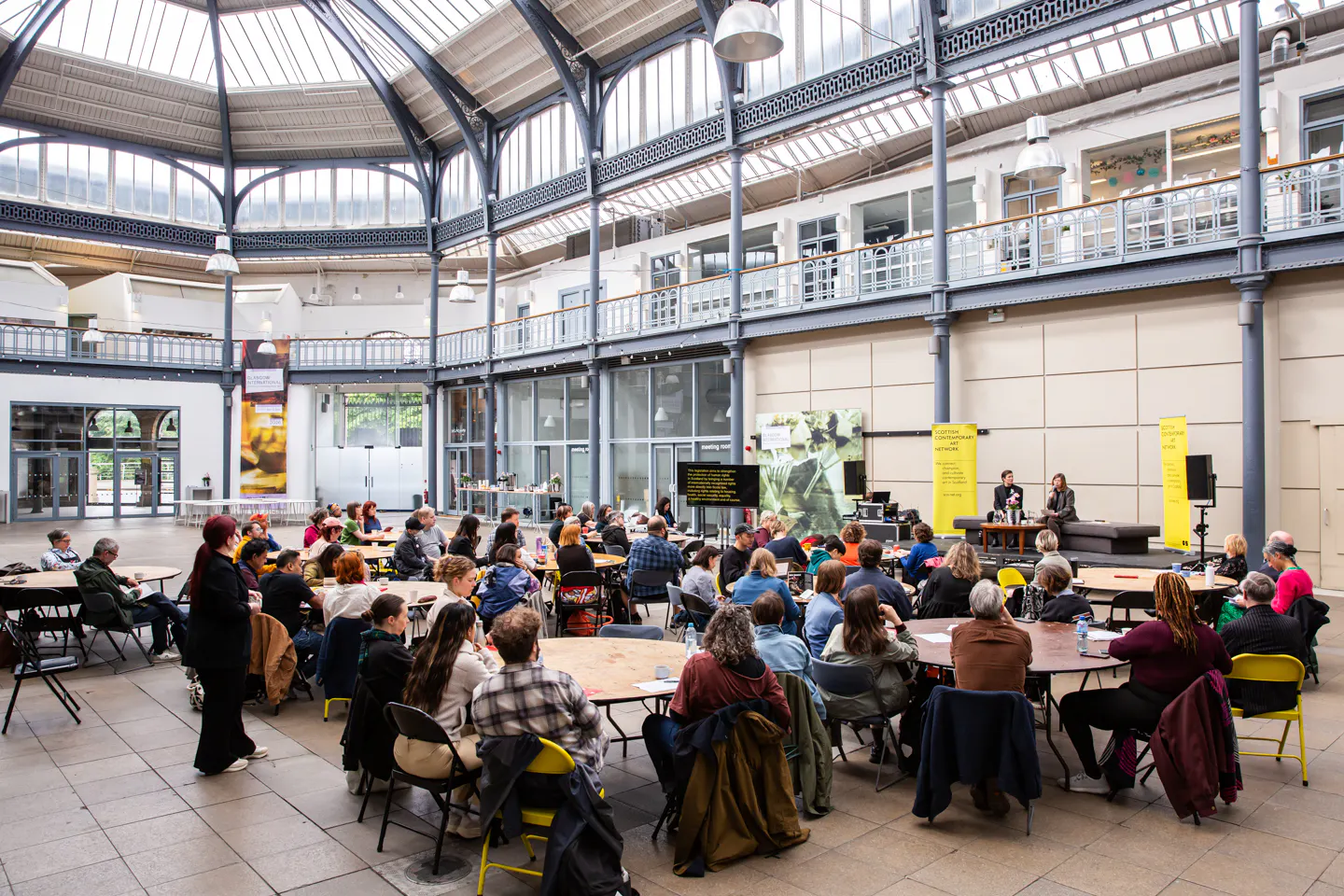
SCAN summit 2026. Photo: Erika Stevenson.
At the beginning of June, Co-Producer Bruce Phillips headed down to Glasgow for the Scottish Contemporary Art Network's annual summit. This year, the programme focused on human rights and the arts. It takes place ahead of a new Human Rights Bill, due to be advanced in Scottish Parliament in May 2026. If the bill is enshrined into Scots Law, the rights of all people in Scotland to participate in a cultural life will become enforceable. Read on for Bruce's reflections on the day.
It’s a privilege to take a day out of your working week to attend a conference or symposium – especially for a small organisation like Deveron Projects where so much of our work requires all hands on deck. When the opportunity comes up you want it to be worth your time and for it to be relevant and generative for your work. I was pleased to find that the 2026 SCAN Summit was well worth it.
The Summit is run annually by the Scottish Contemporary Art Network – an organisation that links up organisations across Scotland to advocate, facilitate and shape conversations that are needed in the art sector. This year's topic ‘take liberty’ provoked a productive and critical discussion concerning the role of human rights for artists and art organisations. Timed with the Scottish Government’s proposed Human Rights Bill, the summit sought to expand what this new legal framework could mean for the cultural sector— its opportunities and limitations.
Keynote speaker Dr Elaine Webster, a Programme Leader in Human Rights Law at University of Strathclyde, explained that this new bill will set a first for the UK where participation in cultural life will be protected in law. The bill is the result of 8 years development and decades of advocacy and proposes to make four international rights treaties part of Scottish law including the International Covenant on Economic, Social and Cultural Rights of 1976.
Relevant to the arts is that this treaty specifically protects the dignity of all individuals and communities to “take part in cultural life” and for nation states to make a provision for cultural freedom, production, research and international cooperation. Elaine stressed, however, that this bill will at best set a minimum level of rights, whereby public authorities will be issued with baseline duties to either comply with or consider. In practice, Elaine argued, the bill will require pressure from communities and the cultural sector to put the law into action. She emphasised that law always lags behind best practice and so it’s up to the sector to use this bill to create a ground swell that politicians can’t ignore. “Human rights restrict the power of politicians”, Elaine cautioned, “so they will naturally resist it” unless we apply pressure and show how it can be put to work.
Part of this potential work was teased out in the subsequent panel discussion. Of this discussion Helen Trew, Director of Art 27, highlighted the potential of this bill to validate the work already undertaken by organisations such as hers -- Art 27’s namesake being Article 27 from The Universal Declaration of Human Rights of 1948 that “everyone has the right freely to participate in the cultural life of the community, to enjoy the arts and to share in scientific advancement and its benefits.” Drawing on her experience of artist-led initiatives in Belfast during The Troubles, Helen pointed out that art and artists have always been integral to social change. When the likes of Reform politicians argue for a homogenous British cultural identity of “one common culture, one common language” this is when a bill of human rights protecting cultural freedom is critical. This is a time, Helen cautioned, where we need to make sure art and culture is not dismissed or co-opted by fascist agendas.
Subsequent contributions drew out the nuances and thorny contradictions unsaid within the earlier discussions. Through a discussion of his work THROUGH A MIRROR, DARKLY currently on show at the Hunterian Museum, artist Naeem Mohaiemen drew attention to the role of art in creating space for ambiguity, contradiction and complexity. Naeem pointed out the drawbacks of the two predominant approaches for advocating for human rights – the acceleration approach where activists point out the failure of the state or an institution and provoke it into collapse; and the negotiation approach that seeks to bring about change by work within the system. Where both these approaches fall short, according to Naeem, is the realm where art can provide a critical role by creating space where uncomfortable things such as two opposing ideas can be held without resolution. He admitted that, while the social impact of this approach might take longer and won’t create a clear call to action, it nevertheless has other long lasting benefits that are hard to fathom from our contemporary moment.
After the lunch break So Mayer, a writer, organiser and curator, and Dr. Nat Raha, a poet and activist-scholar, led a passionate discussion on the absence of LGBTQ+ culture within the discussion of human rights. They argued that there is an underlying normalisation in the way the bill had been discussed that excludes expressions of sexual freedom and non-binary gender. Nat pointed out that such a prudish mindset is essentially a continuation of the British colonial project – that sought to expand the empire literally through White heterosexual reproduction and cultural homogeneity. Important here is that, in addressing cultural life as a human right, artists and cultural producers have an influential role in either reinforcing this regime of normalisation or to challenge it. For Nat the fight for human rights is all about “who gets control over space” and so when we encounter such oppressions we should name them and seek solidarity with others to dismantle them. To this point, So highlighted the right to culture inherently implicates the body – for instance if trans people are prevented from accessing public toilets then it makes sense to support and work alongside disability advocates who are already fighting for greater access to public facilities as a human right. “Laws are always undercut by the material”, Nat concluded, and gave the example of when the 2010 Equalities Act was passed it happened to coincide with legal aid being reduced – meaning that those that experience discrimination the most were also socioeconomically more in need of legal aid and were thereby prevented by seeking justice under the new law.
Throughout the day the pendulum swung between the possibilities of the proposed bill and the shortcomings of such legal frameworks to be put to use. Equally present was a tension between the need for action versus the need to ‘call-in’ opposing views and welcome complexity. Yet cutting through this friction was a consensus for cooperation across disciplines and finding solidarity in points of convergence –or– in the words of Helen Trew: “we need to get out of our bubbles, we need to sharpen our wits.” On the train back to Huntly I couldn't help feeling that I was returning to my bubble. The Summit gave me much to consider in terms of how the Scottish Government’s proposed Human Rights Bill might be leveraged for the benefit of the artists and communities that Deveron Projects serves – and – how we should indeed be ‘sharpening our wits’ in a political climate that is increasingly hostile to such rights.