Maypole
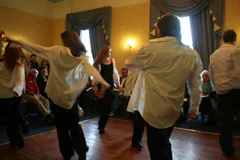
Leàn Coetzer is a dancer and choreographer who came from Pretoria South Africa for 5 months during Spring 2008 with her husband Jacques and children Jan and Juliana.
While in Huntly Leàn discovered a need for us to move more. But are exercise classes the answer to our modern style of living spent mainly in front of the computer? To what extent can choreography enter our lives? In celebrations? Everyday activities?
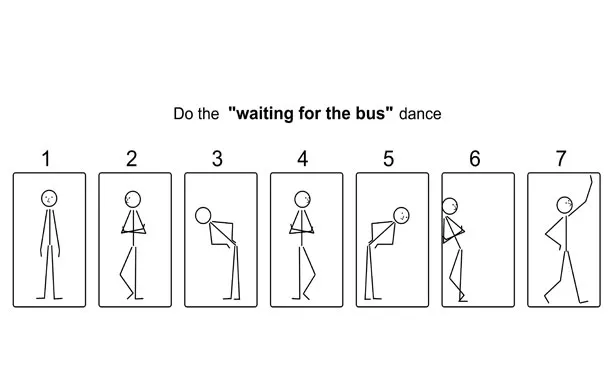
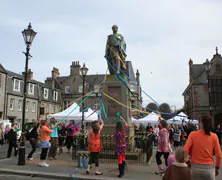
As a choreographer, Leàn was interested in exploring our everyday travelling while also acknowledging the traditional forms of movement we undertake during celebrations; particularly focusing around the ancient ritual of dancing around the Maypole. Leàn’s Maypole dance in the town square during the Ronald Center celebrations allowed each of the dancers to skip around the Duke of Richmond monument with a reel of ribbon - in a manner that produced a Gordon Highlander tartan around the Duke. This simple gesture shows the inherent creativity in celebration and movement, while also creating a visible link between this activity and the traditions of a spring event and the tartan heritage of Huntly. As well as this, and Lean's involvement within the community on further dance related projects, she produced a town collection piece for our local bus stop that allows the many people waiting there every day to consider their own daily movements, and to what extent they are choreographed. The Bus Stop Dance indicates a five-step diagram of various movements related to waiting for a bus - are these movements devised by Leàn herself from her own experience, or observations of others? Standing at the bus stop, one may ask whether she has pre-empted their own movements, or if they find the 'dance' to be a completely new choreography. Of course, many people found they do not seamlessly perform this routine daily in perfect unison, but rather Lean's image reflects the individual rhythms of the Huntly residents through the dynamic and diverse range of poses associated with waiting for the bus. Though, of course, it is also possible that the language of our daily movements all draw from the same lexicon of signs.