27 August 2025
News from the gardens: July & August
A monthly blog by Garden Caretaker, Lindy Young, sharing news and updates from the Brander Community Garden
Deveron Projects has cared for the Brander Community Garden for over 15 years. During this time it has been developed through lots of projects, including A Bite on the Side with Norma D Hunter giving the garden lovely apple trees, Flax Turns with Christine Borland creating distinctive wedge-shaped beds in the lower garden for growing flax, The Town is the Garden creating compost bays and raised beds, a greenhouse and shed. Most recently, the Caretakers' Garden has explored the networks of care within the garden, human and more-than-human. Led by Lindy Young, we offered workshops and events focused on biodiverse gardening and created a no-dig bed, a perennial wild meadow and food forest. Celebrating this project, we are about to launch a Garden Care Plan, written by Lindy. This blog by Lindy gives an insight into this publication, and what's happening in the garden too! July & August’s news from the garden has been co-authored by both Lindy and Jess (Deveron Projects Co-Producer).
You can visit the Brander Community Garden behind the library at any time. It is accessed via a white metal gate at the top of McVeagh Street. If you would like to get involved, pop by on a Tuesday to meet Lindy and get stuck in.
July & August — No-Dig? No Problem!
The Summer has flown by and it is hard to believe that the glorious weather has lasted this long. Amongst hot and dry weather, we have even had some great downpours and nights of heavy rain to keep the garden healthy and to fill our water butts.
It is fascinating to go round the garden and notice which parts are thriving and which have struggled during the spells of heat and limited rain. The pumpkins, planted in pots back in April by the Numero Uno Group, are looking amazing. One or two are bigger than football sized. The other Cucurbits (Cucurbitaceae family) - the cucumbers and courgette - are also doing amazing. One courgette, out in the raised beds, has reached the monstrous weight of 2.7kg!
Watching the garden’s produce grow has had Lindy reflecting on its fifteen year journey to where it is today, and more broadly on how gardens have been developed over centuries throughout the world. During a brief trip away from the Brander Community Garden, Lindy went to see the V&A Dundee’s Garden Futures: Designing with Nature exhibition. Lindy appreciated that the exhibition didn’t shy away from the fact that gardens and gardening have often reinforced and underpinned colonialism and have been a part of reinforcing inequalities and repression throughout the world. Zionist plans in Palestine, for example, often used tree planting as a tool of ‘green colonialism’: although not a garden, the Birya forest is Israel’s largest man made forest in the north of occupied Palestine and was strategically planted over the ruins of six Palestinian villages1. In similar vein, Corinne Silva’s work Garden State, exhibited as part of the exhibition, documents the public and private gardens across 22 Israeli settlements: settlements that contributed to the erasure of Palestinian villages destroyed in 1948 as part of the Nakba. Exploring ways that gardens and gardening can be representative of Israel's expansionist ambitions, Silva’s images are examples of claims to territory that are made through landscaping, and the resulting naturalisation of violence. Both of these examples, along with many more similar cases, show a deliberate disregard for indigenous plants, planting, and land stewardship under the guise of supposed environmental conservation processes to ‘turn the desert green’ - a Zionist trope often used to distract from greenwashing, colonialism, and imperialism.
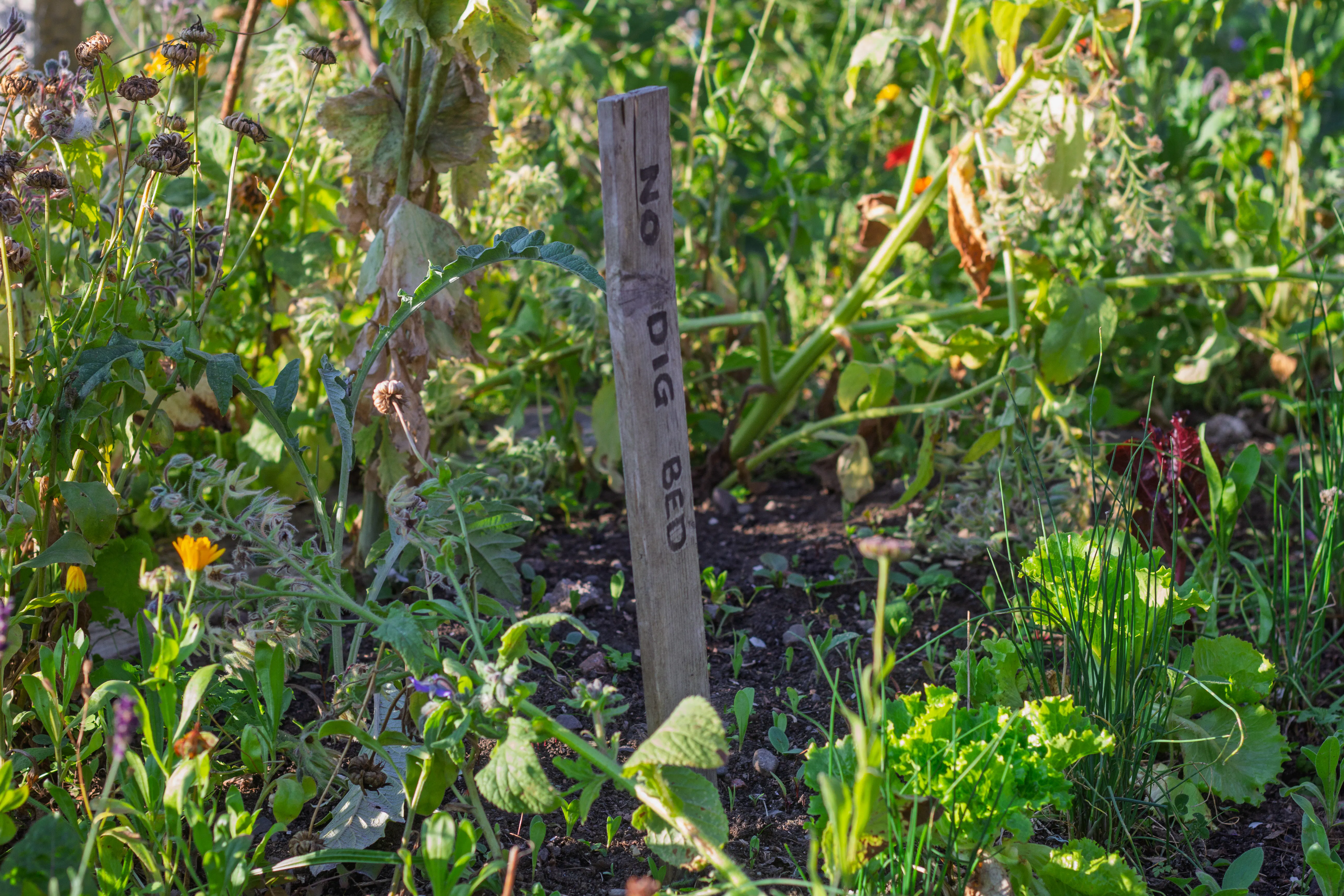
So, what methods of learning from and understanding the land can we use to deconstruct colonial narratives both globally and at home? One of our initiatives into creating environments where plants, fungi, and beasties can work together to create a healthy balance has been our no-dig bed. It seems to have managed particularly well with the extreme conditions this Summer, without requiring too much watering or attention. No-dig is a permaculture method which requires beds to be topped up with fresh organic material each year, or between crops, rather than being dug over. The resulting growing area is very hummus rich and light, retaining moisture better than dug over garden soil and creating an easier environment for weeding due to roots having less of a hold. The idea is that planting material is built up in layers, while the underlying soil and the micro-organisms, bacteria and fungi that keep the soil healthy are left undisturbed. It’s a method that is about much more than just what can be harvested: it is about the other life forms that exist in and around the plot - those that are seen and those that are much more invisible to the human eye. It is this that reminds us of the message that Garden Futures had: that gardening for both communities and for nature are critical for the future in order to help both humans and other species to adapt and cope with climate change.
As with anything, building these relationships takes time: our no-dig bed is now three years old. Building the bed began with layering cardboard straight onto turf. We then layered grass cuttings, seaweed, straw, leaves and garden compost on top and it was planted almost immediately. Each year we add more layers of whatever is available, mainly horse manure, leaves and our own home-made compost. This year we are growing runner beans, mangetout peas, salad leaves and kale. Only the mangetout suffered due to lack of rain. We have already harvested a row of turnips and the whole bed is interspersed with borage, marigold and feverfew. Along the front we are growing herbs such as lavender and chives. So far it is colourful and tasty and filled with bees and butterflies. Since new material is being added regularly it is less crucial to rotate crops, although we try not to plant exactly the same things each year.
A plant that has continuously gifted us with the produce every year is our Victoria Plum. Earlier this Summer, it was brutally attacked by aphids, but luckily it looks like it is going to be fine. It has plenty of new leaves and the surviving fruit is looking promising for a decent harvest later in August. On the topic of fruit, for the first time ever we were eating cherries off our tree and they were delicious. We netted most of the tree to keep the birds off, something we have never bothered to do before, but it was worth the effort. Normally, any cherries disappear practically overnight as soon as they are ripe.
With so many early harvests we were a little concerned that everything might be over too quickly. With this in mind, Lindy has recently planted more beetroot and lettuce seeds to see if we can extend this amazing summer as long as possible. It’s quite late in the season but they may make it to baby beetroot size before the hard frosts of late autumn - a slightly sad thought when we have enjoyed such warmth this Summer. That said, with Autumn’s arrival in the next few months, we can look forward to other things like carving pumpkins and making copious amounts of courgette chutney.
In this blog, Lindy and Jess speak about the V&A Dundee’s Garden Futures: Designing with Nature exhibition. Exhibited as part of it is a town planning report produced in 1925 by Scottish figure Patrick Geddes, as part of the Zionist vision for a ‘garden city’ named Tel Aviv - a plan which could only be realised through the systematic depopulation and destruction of the Palestinian region of Jaffa. Although the V&A have now shared that the object is sourced from Creative Commons, it is still credited to the National Library of Israel and therefore shows tacit disregard for the destruction of Palestinian libraries and cultural centres amidst ongoing genocide. We echo the calls of Art Workers for Palestine Dundee and Art Workers for Palestine Scotland that are laid out in their open letter to the V&A Dundee, and reiterate their calls along with V&A Dundee’s Young People’s Collective for V&A Dundee to endorse PACBI (the Palestinian Campaign for the Academic and Cultural Boycott of Israel) and commit to BDS (Boycott, Divest, Sanction) policies within the museum.
Click here to read and sign the open letter to the V&A Dundee.
Click here for continued updates from Art Workers for Palestine Dundee via their Instagram account.
1 https://slowfactory.earth/readings/green-colonialism-in-palestine/