Deveron Projects borrows its name from the river that runs through Huntly. Bubbling up in the Cabrach, the river Deveron meets the river Bogie in Huntly and then flows onwards and out to the Moray coast at Banff.
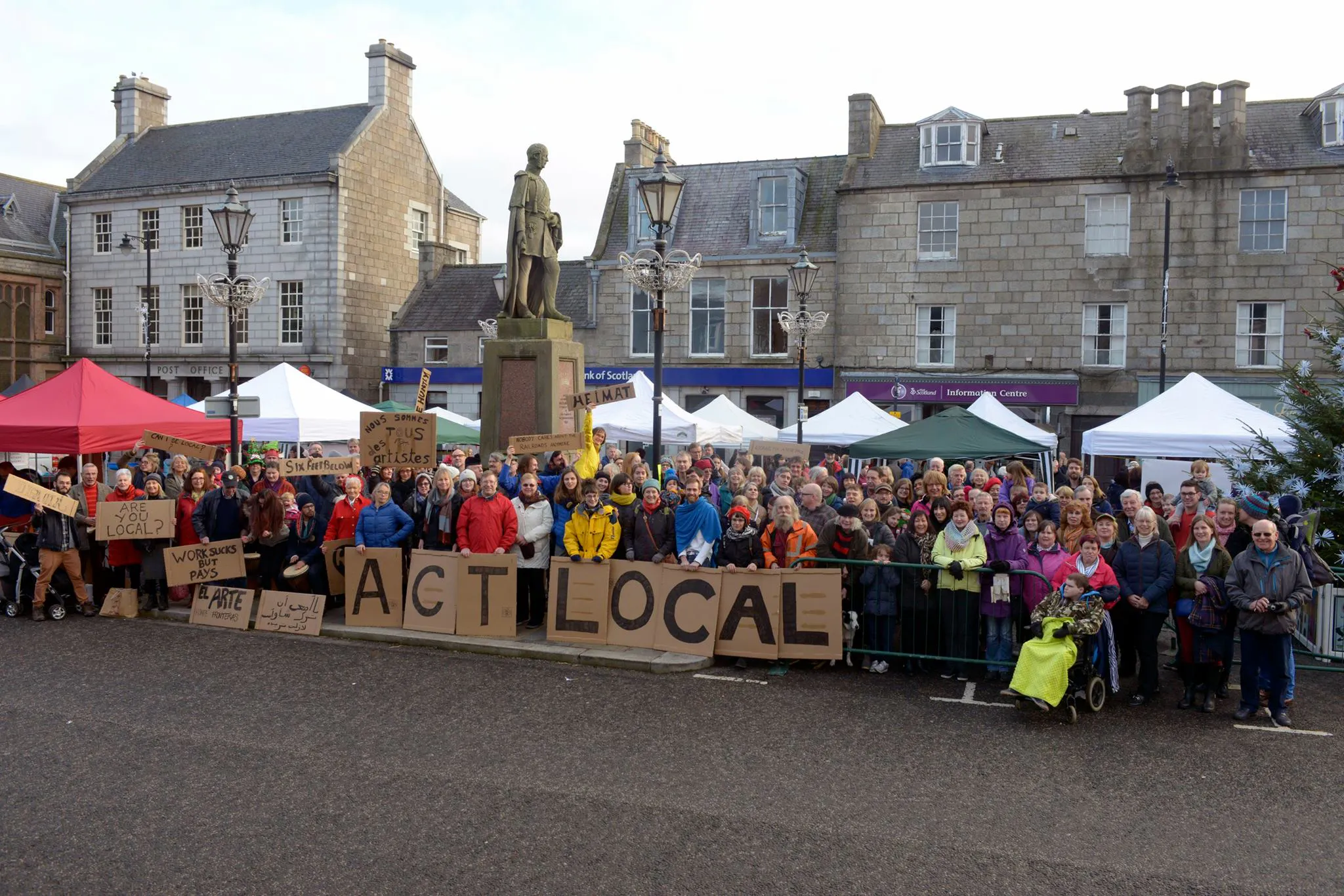
Deveron Projects was founded as Deveron Arts in 1995 by anthropologist Claudia Zeiske, with two friends, Annette Gisselbaek, an art collector and Jean Longley, a fundraiser. Claudia Zeiske went on to lead the organisation for 25 years, during which time Deveron Projects became one of the UK's leading socially-engaged arts organisations.
Initially, Deveron Arts invited work that had been made in cities to visit Huntly - touring exhibitions, theatre - and undertook a feasibility study for developing an arts centre in Huntly. Fortunately, the negative outcome from this set the organisation on its course for developing alternative ways to make and share artwork in places like Huntly, that have undoubtedly shaped current understandings of socially-engaged, place-based, community and rural arts practice across the world.
Around the same time, speaking with students at Gray's School of Art in Aberdeen, Claudia Zeiske learned of how little opportunity there was for artists post-graduation in the north-east. Hosting an exhibition called Three Degrees in Huntly by 4 students, one artist, Ewan McClure, stayed for several months after in exchange for a couple of paintings. This was the start of an artists' residency programme that invited artists from all over the world to live and work in Huntly.
From this point, over 100 projects with over 100 artists formed the first 25 years of Deveron Arts. You can learn more about each one in our digital and physical archives, and in this lecture by Claudia Zeiske, recorded in 2020:
Claudia Zeiske talks about the first 25 years of Deveron Arts/Projects.
Coinciding with Deveron Arts' 21st anniversary, the name of the organisation was changed to Deveron Projects. In the Deveron Express, a quarterly newsletter published by the organisation, Claudia Zeiske wrote of how the 21st anniversary marks a coming of age. She reflects on the wider context and world events at the time, and the role of an arts organisation within this, before concluding, "It is our affection for our community and the patience to develop projects specific to our local culture, landscape, population and history that drives our work. Hence, Deveron Projects, or is it Deveron Projects? I am grateful to Mark Stephen who alerted us to this word play of projects/ projects".
In 2020, during the Covid-19 pandemic, Deveron Projects celebrated its 25th anniversary. This was marked by a change in leadership as Claudia Zeiske moved on, after 25 years, to focus on her PhD.
Natalia Palombo stepped into an organisation that had seen significant shifts and completed ambitious, (inter)nationally recognised projects - Town is the Garden, Weeping Willow Tree and White Wood to name a few. In 2018, aligning with Huntly's Town Strategy, Deveron Projects had purchased Square Deal, an empty shop on Huntly Square. The second phase of this capital project, led by Project Manager Robyn Wolsley was underway when the organisation also received the Scottish Government's inaugural Culture Collective funding.
These changes marked a shift in scale, scope and potential for Deveron Projects. This coincided with the peak of the Covid-19 pandemic, a moment that instigated a critical discourse on how the arts sector is structured, how artists are supported and the value of the arts in supporting communities' Covid recovery and future ambitions. At Deveron Projects, we made space to reflect, not only in response to global shifts and concurrent justice movements, but also on longstanding issues within the sector such as overworking and inequitable, harmful structures.
Deveron Projects became an active part of Huntly’s response to the pandemic. We listened closely to artists and local communities as we expanded and developed our approach to collaboration, embedded fair work practices across the organisation. The team embraced the opportunity to consolidate a period of internal development and reflection into an experimental and ambitious programme of artists' residency commissions between 2020-24.
Natalia Palombo's Directorship established a focus on hospitality, care and sustainability, and instigated an organisational transition that is still ongoing today. The renewed sense of purpose and refreshed vision, values and aims that emerged through her Directorship were put into action as Natalia restructured the team, before saying goodbye to Deveron Projects in 2024. In her place, a Co-Directorship is now shared between team members Jenny Salmean (previously Producer) and Matthew Evans (previously Project Manager), designed for more sustainable leadership, and reflecting the first step in decentralising power and decision making within a socially-engaged arts organisation.
You can read more about the current team online here. There is information about how we are working together now here.
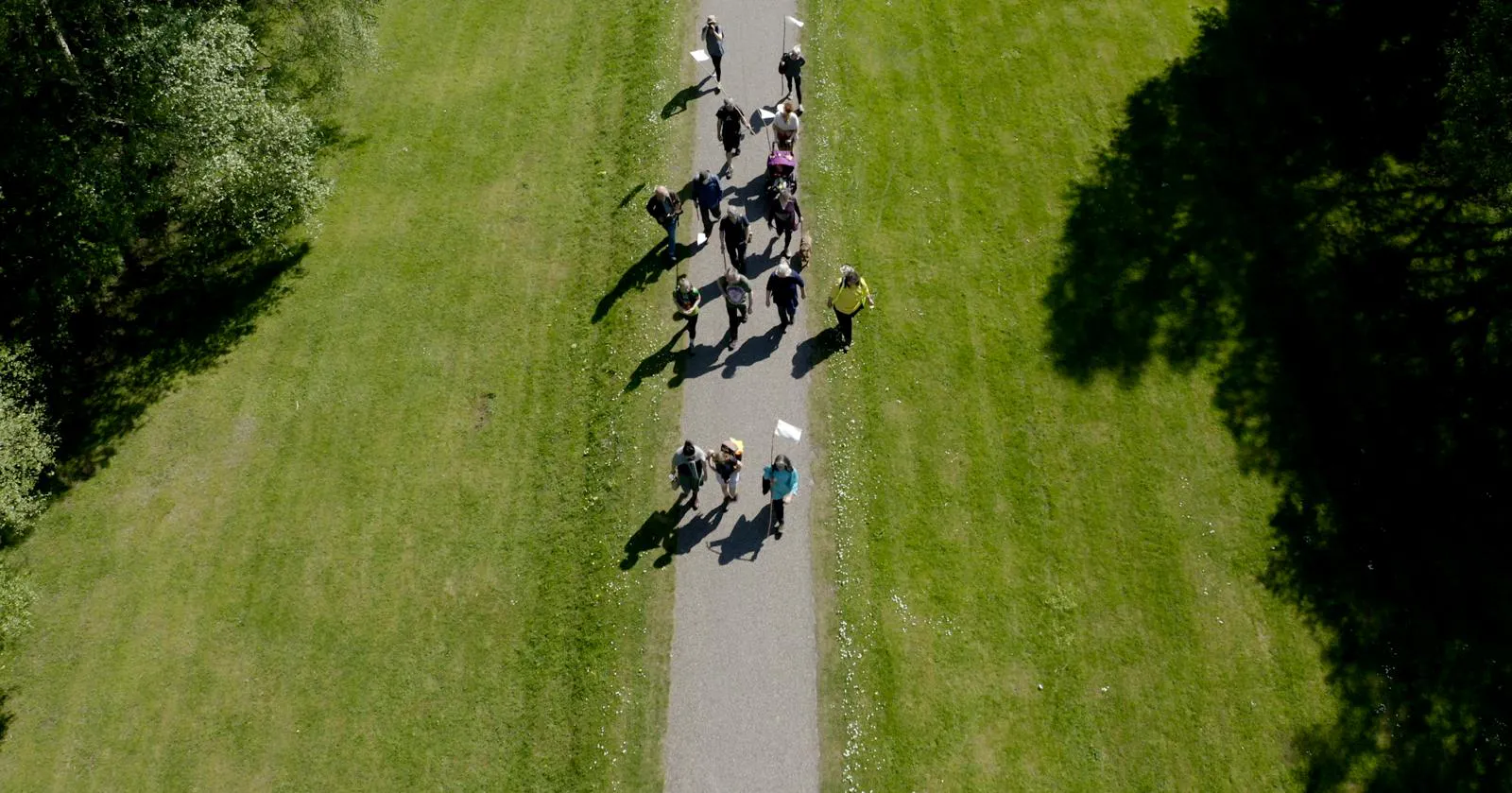
Memory Walk to the White Wood (2021)
Claudia Zeiske developed methodologies that shaped the organisation and the projects it produced. Drawing from her background as an anthropologist and building from her experience of working with artists in Huntly, she was particularly inspired by artist Joseph Beuys and town planner Patrick Geddes.
The organisation's maxim for 30 years, the Town is the Venue described how and where Deveron Projects worked. Instead of working from a gallery or art centre, the organisation worked across the town and surrounding areas, in 'found' places and spaces, and with the people who inhabit them. Themes and topics for projects came from the town and dealt with local issues that connected with everyday life in Huntly, yet were globally relevant, for example health and wellbeing, environment, heritage, economy and identity.
This approach remains the foundation for our work today, yet we now think and speak of "working in public" as this better reflects the transparency, politics and power dynamics we are trying to foster in our work today.
This term was created by Nuno Sacramento and Claudia Zeiske in their 2010 book of the same name, ARTocracy - Art, Informal Space and Social Consequence: A Curatorial Handbook in Collaborative Practice. The book systematically explains how their creative process was applied through layers of people, context, processes and outcomes/outputs. It is out of print but there is a copy in our socially-engaged art library.
ARTocracy is described as a creative method used within the Town is the Venue framework. It is based in the idea that everyone has creative power, which exists beyond art that is shown in galleries.
It also speaks to the role of artists as "cultural activists" whose work can solve problems, offer new perspectives, build connection and open up new possibilities.
We still believe strongly in the power of cultural democracy and aim to enact this through our programmes in ways that are emergent, flexible and critical. You can read more about our approach to this work today here.
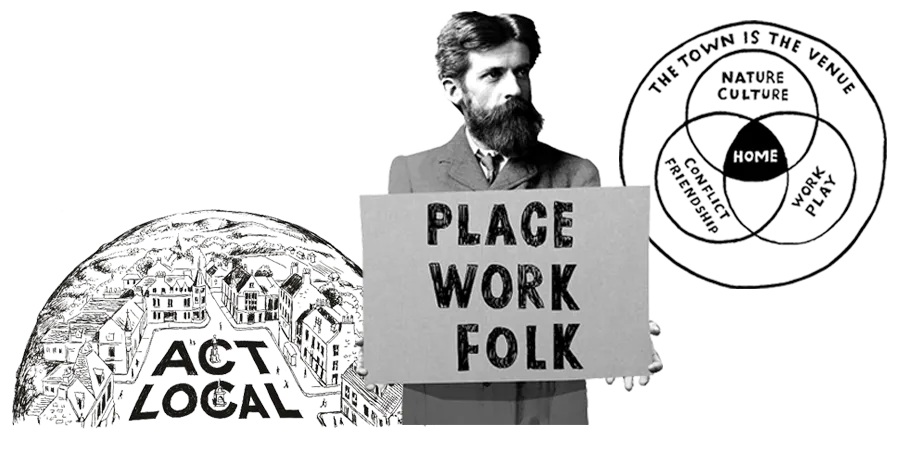
Inspired by Aberdeenshire-born town planner Patrick Geddes (and sometimes credited to him), Think Global, Act Local, describes the world as an interconnected, biodiverse system. It speaks to a belief that working locally on a small scale can have a global effect, but also recognises that what happens here doesn't happen in isolation- that it is always connected with the wider world.
Geddes' Place / Work / Folk model shaped Claudia Zeiske's vision for Deveron Projects. It defines what he believed to be the three balanced needs of the individual, which when fulfilled create a 'positive equilibrium'. Claudia speaks of adding 'nature / culture' to Place, conflict / friendship to Folk and play to Work. Following her Directorship, Claudia worked on a project called Place / Art / Folk which reflected on the history of her work at Deveron Projects through the lens of Geddes' thinking machines and Joseph Beuy's idea of social sculpture.
Patrick Geddes played an active role in colonial projects in Palestine and India. We are now working to understand and reflect upon the imperialism within his philosophies and worldview, which sit so centrally to the development of Deveron Projects. We have written more about this here.
Building from Geddes' idea of equilibrium and balance, the 50 / 50 principle was a guideline for Deveron Projects' work, aiming to create balance between what could be considered conflicting interests and agendas.
Some examples of this are: Artist / Community, Ideas / Reality, Tension / Solution, Local / Global, Home / Away, Hospitality / Criticality, Contemporary / Traditional, Young / Old.
While useful for highlighting inevitable tensions in projects, the binary nature of 50/50 sits outwith our developing appreciation of complexity, multiplicity, intersectionality and polyvocality in our work.
All of these methodologies and principles are detailed in depth in Claudia Zeiske's PhD, Transformational Fieldwork, completed in 2022 and available to download from Claudia's website here.
You can read more about how these methodologies have developed into our work today, here.
Deveron Projects has been under the care of many committed and skilled project managers, including Kate Sargeant, Anna Vermehren, Rachael Disbury, Joss Allen, Robyn Wolsley and Matthew Evans.
Alongside, the team also sometimes included others in unique roles, specific to our work. These roles have continued to develop and inform how we work together today.
Catrin Jeans established this role as the Cultural Health Worker from 2013-15. Borrowing methods from community health practitioners, the role aimed to nurture cultural health of the community.
These approaches included:
The Cultural Health Worker built relationships within the local community, listening and supporting community engagement with artists' projects. They also established the former Home Programme, including Friday Lunch.
From the Cultural Health Worker, the Local Programmer was born, quickly becoming the Art and Community Worker. This role was held by Rachael Disbury, Elisabetta Rattalino, Petra Pennington, Jess Carnegie and Misa Brzezicki.
The Art and Community Worker (ACW) was fundamental to the running of Deveron Projects. They were the eyes and ears in the community, building and nurturing relationships with individuals and local organisations, listening and tracing shifts through conversation, hospitality and care.
This role has informed how Deveron Projects works today. We now understand that the work of the Art and Community Worker is the whole team's work, and the role's approach is now the organisation's approach.
As detailed in ARTocracy, the Shadow Curator was a role developed by Nuno Sacramento through his PhD, in practice with Claudia Zeiske. As an embedded critic, the Shadow Curator assisted, mentored, critiqued and consolidated the role of the curator.
"The Shadow Curator is to the Curator what the Shadow Minister is to the Minister: it is the position of peaceful antagonism or of agonism" - Nuno Sacramento.
As with a Shadow Minister in UK politics, the opposition Party appoints an MP to ‘shadow’ each of the members of the Cabinet. Through this 'check and balance' system it can make sure that it looks at every part of the government through thorough questioning. The role of the shadow ministers is clear: to scrutinise the function of the ministers in power and to propose appropriate alternative policies. Unlike the shadow minister, the Shadow Curator is a guest to the art institution that invites them to develop a critical enquiry into the curatorial model it inhabits. This form of peerage and self reflection, maps the curatorial process through querying and critiquing the assumptions of the institution. In other words, it creates a mirror that when held up against a practice, highlights opportunities for critical development.
At Deveron Arts, the work of the Shadow Curator in collaboration with the (appointed) Curator was to be seen as a possibility or opportunity. It was the co-existence, within the same context, of multiple ways of seeing the artists' projects and their connections. As such, the idea functioned as ‘a model of otherwise’, in perpetual motion between the actual project devised by the Director, and the alternative one, proposed by the Shadow Curator.
This role developed over several years, becoming the Shadow Curator Internship, which was undertaken by Anna Reid, Alice Evans, Peter Moosgaard, Rachael Disbury, Joss Allen, Camilla Crosta, Alexander 'Twig' Champion, Anthony Elliott, Elisabetta Rattalino, Kevin McPhee, Duncan Bremner, Gayle Meikle, Stefanie Ford and Ting Fang Hsueh (Meigo).
The work and dedication of interns and assistants throughout Deveron Projects' history is noteworthy and key to understanding how an organisation of our scale was able to produce projects of such ambition and impact. Many of these wonderful people are credited here. We still consider sharing knowledge and skills important to our work - you can read more about learning at Deveron Projects here.